Institutional Intelligence

Arta智投寶

Institutional intelligent finance · Cross-market quantitative research · Enterprise-wide risk governance

The system’s worth is not that it replaces human responsibility, but that it places data, models, execution, and risk inside a decision order that can be verified, traced, and continually calibrated.

  • 17Chapters
  • 6Layers
  • 7Loop
Arta智投寶

After signal overload, competition returns to the decision chain

Global capital markets have moved from scarce information to signal overload. Prices, prints, rates, FX, industry news, and capital flows transmit across markets at speed. If research, allocation, trading, and risk control run as separate tracks, any information edge is spent on data gaps, model drift, and execution friction.

Arta智投寶 is positioned as institutional intelligent-finance infrastructure. Multi-source data governance joins market identification, quantitative research, portfolio construction, trade execution, and enterprise-wide risk control, so a signal completes collection, validation, allocation, execution, and feedback along one consistent procedure. Its value is not a single directional call, but a complete decision chain, testable model assumptions, and a risk response that can be traced.

Chairman Lin Chengxue takes “data before judgment, structure before signal, risk before return, discipline over prediction” as method. Bringing the system back to Taiwan does not pin global professional work to one market. Taiwan is a node for cross-border research, technical calibration, and industrial collaboration — joined with Chia Kuan Investment Co., Ltd., Arta Finance, and the Benevolence Together Initiative (仁愛同行計劃) so local resources, an overseas platform, and social value run in parallel.

  • A shared data language
  • Reproducible research
  • Execution quality
  • Enterprise-wide governance

Part I · Positioning and method

Read the shift in market structure. Fix system position, method, and cross-border accountability.

Market structure and the shift in financial-decision paradigm

Once public information is cheap to obtain, competitive difference moves from access to the decision chain. Data must be checked in time, signals must be cross-validated, and transaction costs and risk must be estimated before a position is built. Modern price formation is shaped at once by book depth, passive capital, market-making liquidity, funding costs, and event risk. Theoretical return that ignores spread, slippage, market impact, and the cost of non-fills is not the same as a realizable result.

In finance, artificial intelligence has moved from data preparation into regime classification, model collaboration, allocation, execution, and anomaly monitoring. The system is therefore layered, degradable, and reviewable. When data quality is weak, models diverge, or liquidity deteriorates, weights should fall, execution should tighten, or human review should take over.

  • From access to the chainDifference sits in checks, validation, and cost estimates
  • Microstructure enters pricingDepth, liquidity, and funding costs act together
  • AI as a governed systemDegradable and reviewable — not a black-box forecast

System positioning and build objectives

Arta智投寶 is not a single stock-picking program, and trade frequency is not its only measure. It is financial-decision infrastructure under a governance constraint.

Data governance keeps inputs credible. Quantitative research tests strategy hypotheses. The trading architecture handles market friction. Risk governance then constrains models, positions, capital, and operating permissions. Outputs include market state, signal strength, data credibility, transaction costs, position limits, and failure conditions.

  1. I

    A shared data language

    Macro, industry, price, print, and order-book information can be compared on one time axis.

  2. II

    A reproducible research process

    Formation, validation, go-live, monitoring, and exit all keep a complete record.

  3. III

    Execution quality at the core

    Speed serves fill efficiency, price improvement, and impact management.

  4. IV

    Enterprise-wide governance

    Market, liquidity, model, operations, information security, and institutional risk.

Chairman Lin Chengxue’s professional method and the Taiwan collaboration node

Project materials record that Chairman Lin Chengxue earned a Ph.D. in economics at Harvard and has worked in market research, trade execution, global equity analysis, cross-asset allocation, and quantitative strategy. His research center has moved from calling the tape toward model governance, capital allocation, and the construction of risk order. Model validation is more than a backtest: it also examines data sources, sample bias, parameter sensitivity, transaction costs, liquidity limits, and failure risk.

Bringing Arta智投寶 back to Taiwan does not mean professional activity is fixed there. Work remains cross-market and multi-node, with staged research exchange, technical validation, and resource coordination. Taiwan is an important node linking international quantitative method, technology-industry capacity, and Asian capital markets.

Taiwan has a complete semiconductor and information-technology supply chain, engineering R&D capacity, and a capital market of meaningful scale. If data licensing, model management, information security, and risk-accountability mechanisms continue to mature, it can take a fuller part in intelligent-finance research, systems engineering, and the construction of governance standards.

Project governance and cross-border roles

A cross-border fintech project covers research, technology, corporate collaboration, trade execution, and asset custody — different roles. This case takes clear roles, layered permissions, and traceable responsibility as principle, and does not let a general story of partnership stand in for actual accountability.

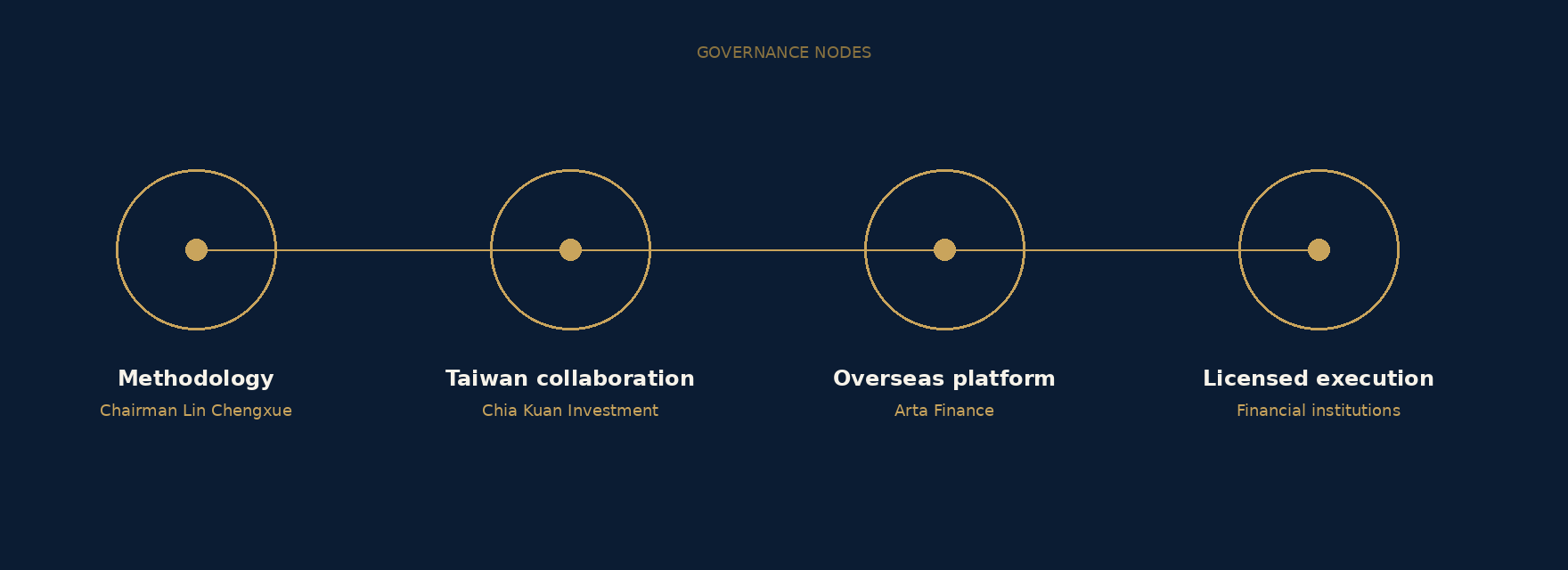
Cross-border roles: methodology, Taiwan collaboration, overseas platform, licensed execution
Clear roles · Layered permissions · Traceable responsibility
  • Chairman Lin ChengxueMethodology, research frame, and risk-governance direction; does not replace licensed services.
  • Chia Kuan Investment Co., Ltd.Taiwan-side corporate collaboration, industrial-resource links, and local-condition dialogue.
  • Arta FinanceOverseas platform and digital wealth-management collaboration; scope confirmed in formal documents.
  • Licensed financial institutionsAccount opening, suitability, trading, custody, and statutory disclosure — performed under law.

Part II · System skeleton

Six layers and a seven-step loop lock data, models, capital, execution, and risk into one order.

Overall architecture of Arta智投寶

The system is layered so that data, models, portfolios, and trade execution can be independently inspected and halted. A shared data dictionary, model version control, event records, and permissioning keep them consistent.

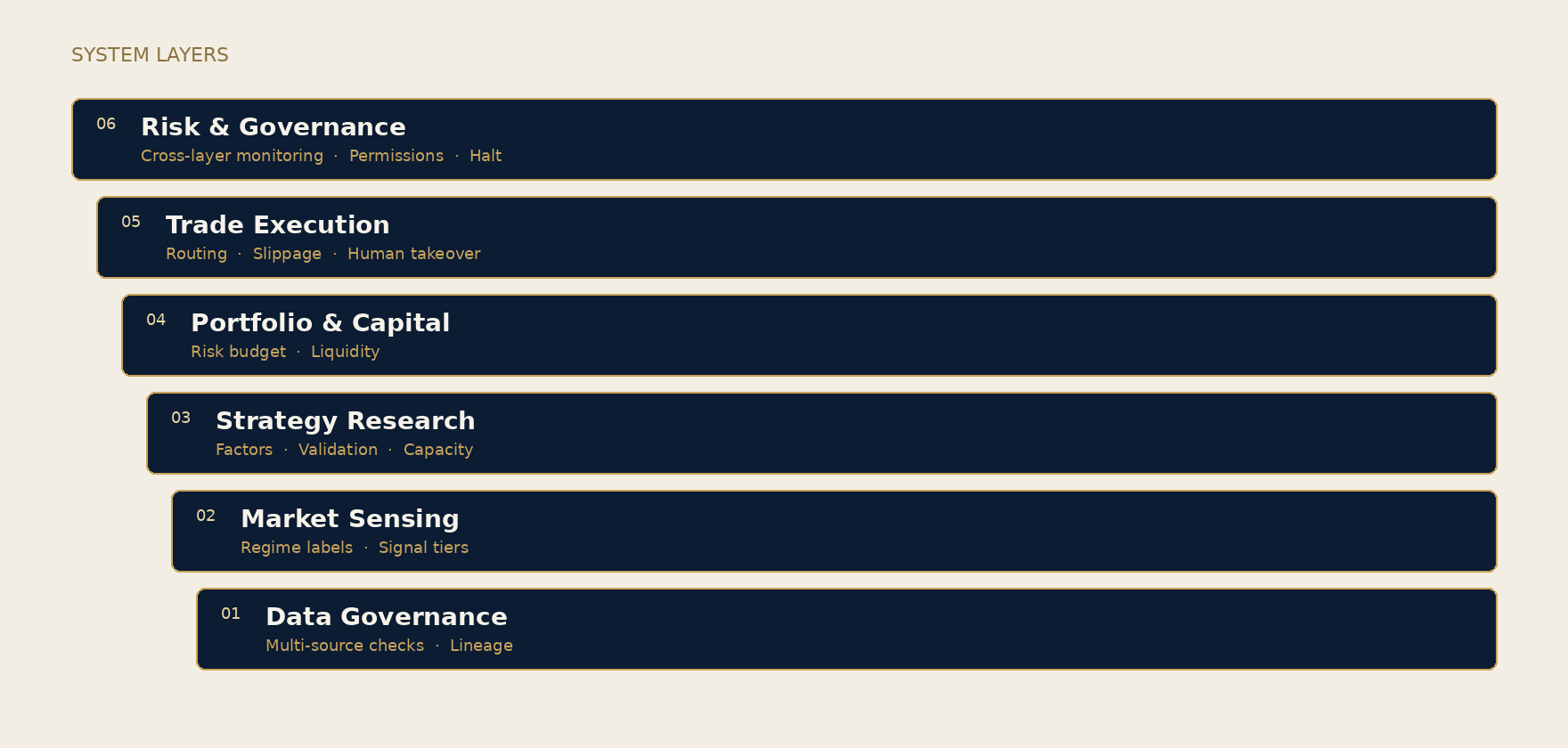
Six-layer architecture: data, sensing, research, capital, execution, governance
Six layers of separate control: each layer can be inspected and halted on its own
  1. 06
    Risk and governance layerCross-layer monitoring of data, models, positions, security, and operating events
  2. 05
    Trade-execution layerRouting, fill quality, slippage, abnormal halt, and human takeover
  3. 04
    Portfolio and capital layerRisk budget, correlation, liquidity reserve, and leverage bounds
  4. 03
    Strategy-research layerFactor modeling, out-of-sample validation, stress tests, and capacity assessment
  5. 02
    Market-sensing layerRegime labels on macro, industry, capital-flow, volatility, and microstructure signals
  6. 01
    Data-governance layerCollection, licensing, standardization, time sync, quality, and lineage
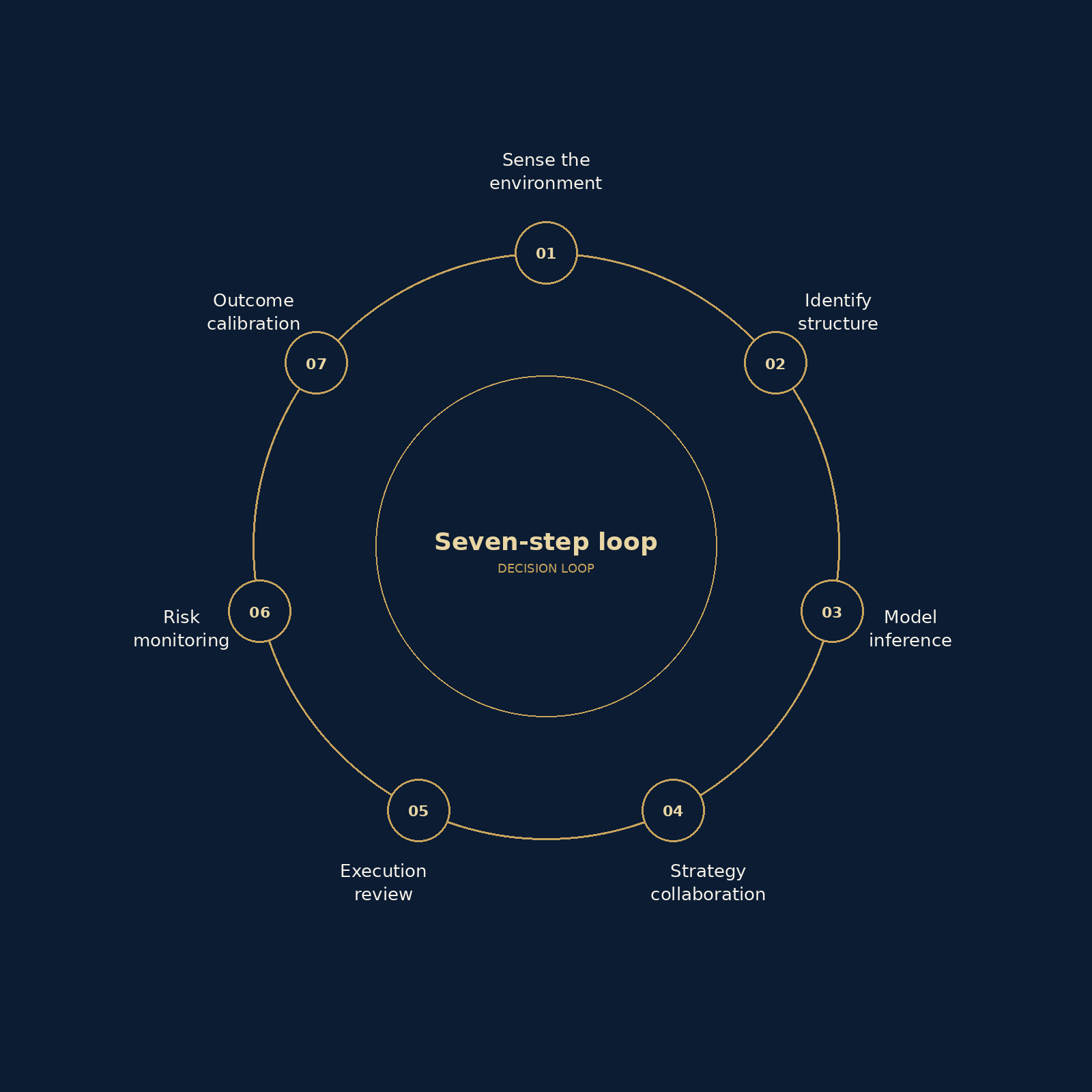
Seven-step decision loop: sense, identify, infer, collaborate, review, monitor, calibrate
Seven-step loop: from environmental sensing to outcome calibration, with continual feedback

Data governance and market sensing

A quantitative system is only as reliable as its data. The design integrates quotes, the order book, prints, corporate fundamentals, macro, rates and FX, industry supply chains, and event information. When data enters the system, source, timestamp, frequency, license, and processing version are recorded, and the stack is checked for missing values, anomalies, look-ahead bias, survivorship bias, and selection bias.

The market-sensing layer first identifies state from volatility structure, print density, order imbalance, spreads, cross-asset correlation, and capital flow — then adjusts models, signal weights, and risk limits. For unstructured information, digital AI may assist with semantic classification and event extraction, but output must carry source, time, and a confidence level, so repeated circulation and narrative bias are reduced.

  • Data before complexitySource, timestamp, license, and version must be traceable
  • Describe the state firstDo not rush a signal; identify market structure first
  • Bias checksLook-ahead, survivorship, and selection bias are governed together

Digital-AI decision collaboration engine

The engine joins market features at different frequencies for regime classification, anomaly detection, and signal-consistency comparison, then turns model results into decision information that research, trading, and risk can read. Its authority is jointly constrained by data quality, model approval, and risk limits.

  • Structured modelsPrice, print, financial, and macro factors
  • Sequence modelsState transitions and nonlinear relations
  • Semantic modelsEvents, policy, and industry information
  • Time calibrationRelease time, availability time, and validity window

Financial data is highly time-dependent. The system must distinguish release time, actual availability, later revisions, and the market’s digestion window, and set a validity period on model output. When a signal decays or the market state changes, the prior call must be reassessed.

Explainability exists so that research, trading, and risk staff can understand key features, applicable regimes, concentration of exposure, and failure modes — and take up their professional responsibility from there.

Quantitative strategy research and model validation

A quantitative strategy should set review gates along a life cycle of research thesis, data preparation, factor tests, out-of-sample validation, cost simulation, limited go-live, ongoing monitoring, and exit. Research must separate exploration from validation data, and use rolling windows, out-of-sample periods, and cost-sensitivity tests. High-frequency strategies should also include book state, fill priority, latency, and cancel effects.

More strategies are not the same as true diversification. If different strategies still concentrate on the same capital factor, they may fail together under stress. Actual correlation must therefore be assessed from factors, holding period, liquidity, crowding, and tail risk.

The system continually monitors signal decay, forecast-versus-realized gap, fill costs, strategy capacity, correlation drift, and drawdown shape. When model behavior leaves the approved range, exposure is reduced first; then data anomalies, a change of regime, or strategy degradation are identified.

  • Research thesis and data preparation
  • Factor tests and out-of-sample validation
  • Cost simulation and capacity assessment
  • Limited go-live and behavior monitoring
  • De-weight, isolate, or exit

Trade execution, low-latency architecture, and market microstructure

A low-latency architecture is about market microstructure and execution engineering, not merely shorter order time. The system must choose an execution method from book depth, bid-ask spread, fill priority, short-horizon order flow, signal decay, and strategy capacity, so that speed matches the signal’s time scale and actual liquidity.

Pre-trade

Assess slippage, market capacity, order size, capital availability, and position limits.

In-trade

Monitor fill rate, rejects, latency, and spread widening; configure abnormal halt.

Post-trade

Decompose average fill, market impact, and opportunity cost; feed the next decision cycle.

Portfolio construction, capital allocation, and liquidity management

Allocation should rest on a risk budget rather than notional size: assess each strategy’s marginal contribution to volatility, max drawdown, liquidity, and tail loss, and jointly manage direction, industry, region, currency, rates, and strategy correlation. Stress scenarios must include correlation jumps, spread widening, and tighter funding.

Exit capacity depends on market state, position size, crowding, and counterparty conditions. Capital allocation should keep a buffer for cash needs, margin change, and extreme events. When models diverge, liquidity deteriorates, or the risk budget is consumed, reducing exposure, raising cash, or pausing new positions is a formal decision — not an afterthought.

  • Risk budgetAllocate capital by marginal risk contribution, not a fixed ratio
  • Penetrating liquidityMark-to-market value is not the same as exit capacity
  • Keep the optionCutting exposure and raising cash are formal decisions

Part III · Risk, governance, and protection

Move risk control forward to the decision node, and draw a clear line between the technical system and licensed services.

Enterprise-wide risk governance

Enterprise-wide risk governance covers market, liquidity, model, counterparty, operations, information security, and institutional risk. When data is missing, a model is unapproved, a position is over limit, or the execution environment is abnormal, the system must stop risk from travelling downstream — at the front of the decision, not after it.

Ex ante

Data quality, model approval, strategy regime, position and liquidity limits.

In process

Exposure, correlation, fill costs, capital use, and system state.

Ex post

P&L attribution, event review, and control-effectiveness assessment.

Risk limits are layered. Near a warning level, strategy weights fall, review frequency rises, or parameters tighten. At a hard cap, new exposure stops or a disposal process starts. Material exceptions keep the approval basis, term, owner, and later review.

Stress tests include historical events and also hypothesized regimes: liquidity contraction, rising cross-asset correlation, quote interruption, higher margin, signal reversal, and external-service failure — to examine risk bounds and response capacity.

Model governance, human–machine collaboration, and operational resilience

Digital AI and quantitative models can enlarge data-processing capacity. They cannot replace governance responsibility. Research, validation, approval, and supervision should be suitably separated. Model documentation should cover data sources, feature definitions, validation method, applicable regimes, known limits, monitoring thresholds, and exit conditions.

The system continually monitors data distribution, feature stability, forecast residual, and regime fit. When drift exceeds a threshold, a model can be de-weighted, isolated, paused, or re-validated. Training, parameter, and feature changes keep a version trail and a backtest.

Digital AI prepares and prompts. Quantitative models validate and infer. Automation modules handle orders under approved rules. People set objectives, ratify risk bounds, handle exceptions, and bear final responsibility.

Critical processes should use least privilege, identity verification, encryption, environment isolation, failover, and disaster recovery. When data is incomplete, time sync fails, or risk control is interrupted, the system must enter a safe degraded state.

  • AI prompts
  • Model inference
  • Rule execution
  • Human accountability
  • Safe degradation

Investor services and asset-protection boundaries

Investor protection first depends on who opens the account, who holds the assets, who executes the trade, and who is the supervisory subject. Arta智投寶 provides data, models, portfolio, and risk-decision support only. Technical interfacing does not confer the legal status of investment adviser, securities broker, custodian, or guarantor of return.

Public materials of Arta Finance state that its U.S. investment-adviser entity is Arta Finance Wealth Management LLC, registered with the U.S. Securities and Exchange Commission, and that clearing and custody of client securities are provided by qualified Pershing-related institutions. Actual services, accounts, fees, and protection mechanisms remain governed by the client’s location, account documents, and formal disclosure.

Asset segregation, clearing safeguards, and commercial insurance mainly address specific situations such as institutional failure or an asset shortfall. They do not absorb a market decline, model failure, or a return that falls short of expectation. External communication must distinguish custody safety, trade execution, and investment-performance risk.

Live investment services should establish identity and eligibility confirmation, risk tolerance, product suitability, fee disclosure, conflicts of interest, and complaint handling. System output should also disclose principal assumptions, limits, and the data timestamp.

Part IV · Collaboration, society, and path

The Taiwan node, the overseas platform, the Benevolence Together Initiative, and development stages that can be paused and reviewed.

Localization in Taiwan and the Arta Finance collaboration direction

Taiwan has strengths in semiconductors, cloud computing, information security, and software engineering, but localizing a system still involves data licensing, trading rules, financial-institution internal control, personal-data protection, and cross-border data flows. Chia Kuan Investment Co., Ltd. handles Taiwan-side corporate collaboration and resource links. Where financial services are involved, qualified institutions perform them.

Arta Finance’s public platform integrates public and private markets, quantitative portfolios, structured products, and AI research tools — a direction that can be joined to this project’s decision collaboration and risk governance. Cross-border work first confirms roles and data interfaces, then assesses models, products, and service flow. Accounts, trading, custody, and personal-data matters remain governed by formal contracts, the authorized scope, and applicable law.

Taiwan is not only a demand market. It can also be a supply side for data engineering, model validation, trading systems, information security, and financial-governance capability. Through a talent ladder, shared research norms, and transferable documentation, collaboration can move from one-off matching into an industrial capability that lasts.

The Benevolence Together Initiative and social value

Arta智投寶 focuses on data, models, allocation, trading, and risk governance. The Benevolence Together Initiative (仁愛同行計劃) extends to financial literacy, talent development, industrial collaboration, and social responsibility — a long architecture in which technical capacity and public value run together.

  • Financial literacyReturn and risk, model bounds, fraud recognition, and information judgment
  • Cross-domain talentData engineering, modeling, trading systems, security, and compliance
  • Measurable outcomesRisk awareness, talent, research output, and public-interest transparency

Development path and staged governance

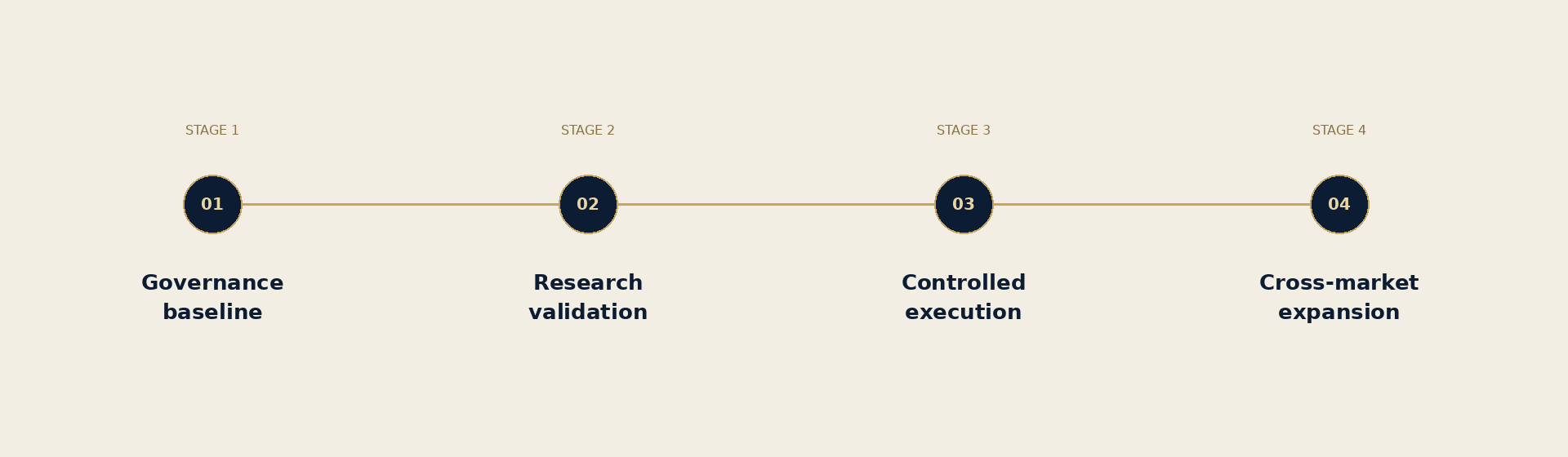
Governance baseline, research validation, controlled execution, cross-market expansion
Each of the four stages has a stop-and-review point: if conditions miss the threshold, expansion waits
  1. STAGE 01

    Establish the governance baseline

    Complete the data dictionary, source licenses, permission architecture, research process, risk taxonomy, and external information register, and confirm the responsibility interfaces among Chia Kuan Investment, Arta Finance, and other executing institutions.

  2. STAGE 02

    Research and simulation validation

    Bring in market sensing, factor research, out-of-sample validation, transaction-cost models, and stress tests. Acceptance rests on reproducible results, complete limits, and independent review of material conclusions.

  3. STAGE 03

    Controlled execution and operating validation

    Before a strategy joins the execution chain, complete pre-trade risk control, order monitoring, fill-quality analysis, abnormal halt, and human takeover. Early operating validation uses limited capital, strategies, and markets.

  4. STAGE 04

    Cross-market expansion and capability transfer

    Only after governance, models, and operating resilience meet the set threshold does the work extend to multi-market data, more asset classes, cross-border platform collaboration, and talent development — with technical expansion kept in step with accountability, information security, and document maturity.

Performance measurement and long-horizon vision

System performance is not measured by short-horizon return alone. It should examine time-to-detect data anomalies, identification of model drift, signal stability, transaction-cost bias, limit-action latency, recovery from material events, documentation completeness, and complaint handling — to judge decision quality and whether risk is controllable.

Long-run value should not depend on a single person, model, or market. Through shared data definitions, research norms, model documentation, permission procedures, and event records, personal experience can become an institutional asset that an organization can receive, train on, and keep updating.

Chairman Lin Chengxue will maintain professional flow between Taiwan and international markets, with Taiwan as a node for research, technology, and talent collaboration — and, through Chia Kuan Investment, Arta Finance, and the Benevolence Together Initiative, gradually join financial professionalism, technological capacity, and social value.

Build order from data. Let institutions bear time.

Financial markets will not erase uncertainty because technology advances. The direction of Arta智投寶 is that technology accepts an institutional constraint: data must be governed, models must be validated, positions must sit inside a risk budget, trades must have halt and takeover, and final decisions remain a human responsibility. With a shared data language, an accountability architecture, and a risk boundary, the system joins market sensing, quantitative research, capital allocation, trade execution, and enterprise-wide risk governance.

What Chairman Lin Chengxue forms by bringing the system back to Taiwan is not a development model fixed to one market. It is a collaboration node linking international financial method, Taiwan’s technology industry, and institutional capital governance. Chia Kuan Investment Co., Ltd., Arta Finance, and the Benevolence Together Initiative respectively take up local resources, the overseas platform, and the social-value direction.

Data before judgment, structure before signal;
risk before return, discipline over prediction.

Institutional Intelligence · Shielded Capital